From Overexcitement to Calmness: 3 Dog Training Transformation Stories
Every dog owner imagines the same thing: a happy, relaxed dog who fits comfortably into daily life. But for many families, the reality can be quite different.
The evenings that should be restful become a wrestling match on the sofa. The simple act of answering the front door turns into noisy chaos. A walk that should clear everyone's heads ends with a frayed lead and frayed nerves.
The following stories of Mia, Bleu, and Coco highlight how very different behaviours can stem from similar underlying issues - and how a structured, thoughtful training approach can transform not just behaviour, but the overall relationship between dog and owner.
Meet The 3 Overexcited Pups
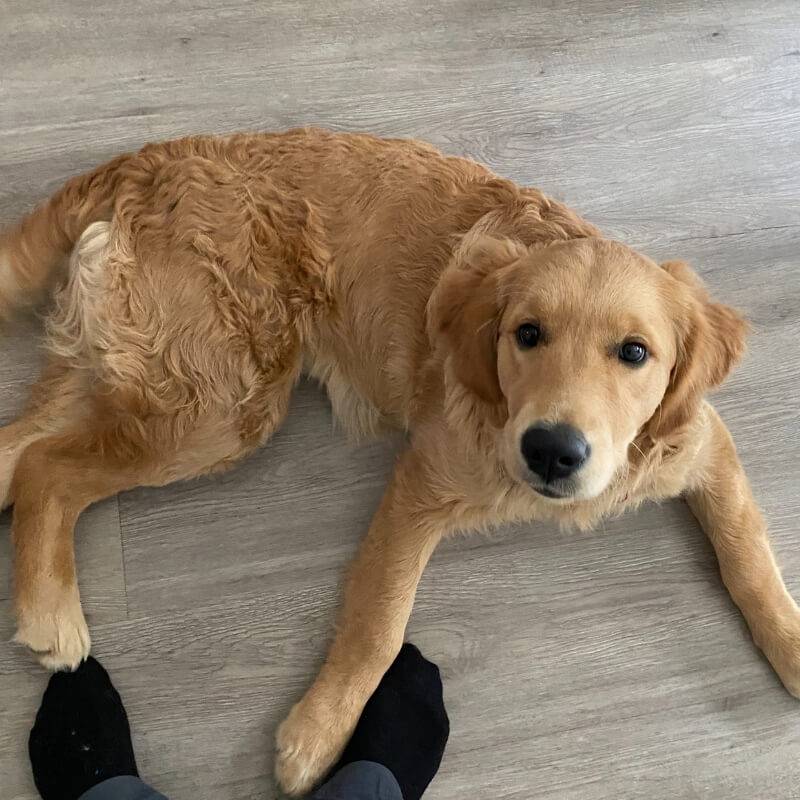
Mia the Golden Retriever
Mia, a five-month-old puppy, got too overexcited in the evenings and would not settle in the lounge.
She would jump on furniture and mouth her owners while they tried to relax on the sofa.
Physical touch or pushing her down off the sofa only made things worse, increasing the mouthing behaviour.

Bleu the Staffordshire Bull Terrier
As a five-month-old puppy, Bleu lived in a busy household where visitors and deliveries were frequent.
His natural friendliness quickly escalated into overexcitement, with jumping and intense greetings becoming a worry whenever someone arrived at the door.
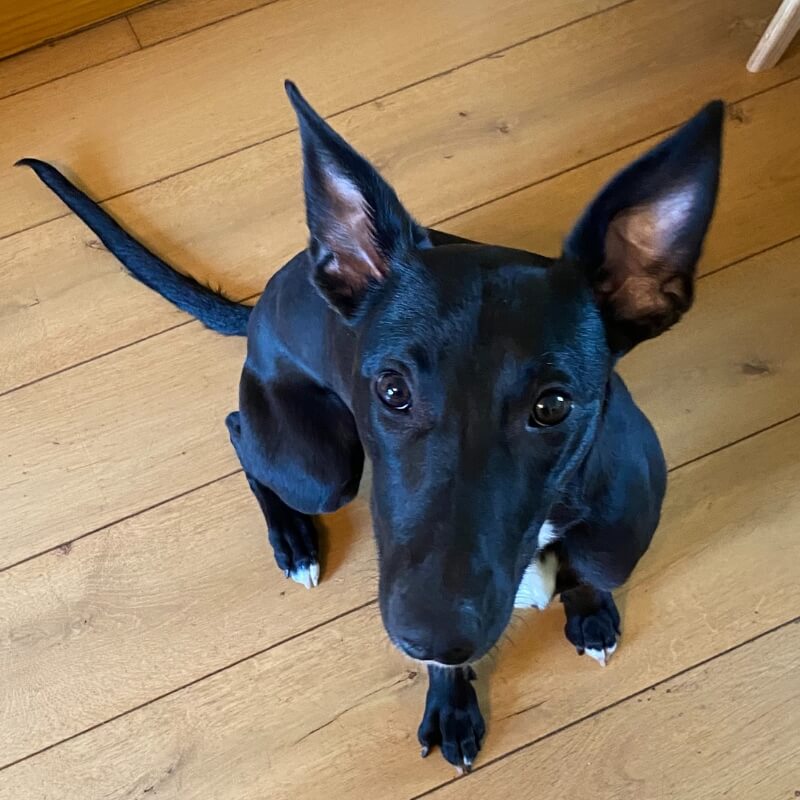
Coco the Whippet/Border Collie Mix
Seven-month-old Coco presented a broader range of challenges. As a high-energy rescue dog, her behaviour spilled into multiple areas, including on walks, at home, and in the garden.
Lead biting, jumping, barking at windows, and difficulty settling all pointed to a dog overwhelmed by both her environment and her own energy levels.
The Dogs Behaviour Problems
Looking closely at Mia, Bleu, and Coco, a shared story begins to emerge. What each of them lacked was a clear understanding of what calm behaviour looked like.
Each dog was acting in a way that made sense to them - seeking attention, engaging with people, or reacting to stimuli - because they hadn’t been shown what was expected instead.
For Mia, the lounge was a novelty. Having had little access to the room as a younger puppy, being let in felt like a big event rather than a routine, and so she responded accordingly.
For Bleu, visitors represented the most exciting thing in his world, and nobody had yet shown him that there was a calmer, equally rewarding way to respond to them.
For Coco, it was the sheer volume of stimulation. Inside the house, outside the house, on walks - combined with unmet physical needs that kept her in a constant state of alert.
The Training Approach
Rather than addressing each behaviour in isolation, the training focused on building calmness as a skill - one that could be practised, reinforced, and gradually applied across different situations.
For Mia, the key was changing the meaning of the lounge. Instead of being an exciting, unrestricted space, it became an area for short, structured sessions.
A bed placed near the seating area gave her a clear role: settle and relax. By rewarding calm behaviour and limiting unstructured access, she learned that being close to her owners didn’t require jumping or mouthing.
Bleu’s training centred around redefining visitor interactions. Instead of reacting in the moment, he was taught what to do before the door even opened.
Starting with familiar people, the doorbell would ring, and Bleu was guided to his bed, where he remained settled while the owner opened and closed the door. Gradually, the interactions built up to include brief conversations, exchanging items, and led up to visitors entering - all with Bleu continuing to stay on his bed.
The goal was to rewire his association entirely, so that a knock at the door became a cue for calm rather than a rush of energy.
Coco required a more holistic approach. Due to her breed, Coco required a great deal of physical activity, and I worked with her owners to identify the right balance and type of activity provided over a week to ensure her needs were met.
We built her response to her recall cue through training games and close proximity exercises.
Her diet was also reviewed to ensure that she was getting the right level of nutrition to match her energy levels in order to maintain a good weight.
Inside the home, window film was applied to reduce the visual stimulation that triggered her barking, allowing her to begin practising calmer responses without being constantly overwhelmed.
Engage and disengage exercises were used to build her ability to look away from exciting things.
We also built a very strong boundary/bed behaviour and proved this with bed stations at doorways, giving Coco a practised alternative behaviour.
With all three dogs, one principle remained constant: calmness was actively taught and consistently rewarded.
The Transformations
As training progressed, each dog began to show meaningful changes - not just in specific behaviours, but in their overall ability to cope with everyday life.
With consistency and practice, Mia became more settled in the lounge, and she started to understand what was expected, so they could all relax in the evenings together.
Bleu learned a calmer response to people, and over time, with this approach, Bleu would learn that visitors equal calmness instead of overexcitement.
Coco’s transformation was perhaps the most wide-ranging. Following the training program, Coco was able to go for walks both on and off-lead and was more responsive and relaxed.
She responded to recall and was able to quickly settle with training cues if she got overexcited. She was able to relax in the home and could be distracted away from windows and doors. Her exit out the door into the garden was calmer, and her behaviour in the garden was also much more relaxed.
Summary
These stories highlight an important shift in perspective. Overexcited behaviour isn’t something to suppress - it’s something to understand and reshape.
When dogs are given clear guidance, appropriate structure, and the opportunity to practice calm behaviour in a controlled way, they are more than capable of learning how to navigate even the most stimulating environments.
Calmness, like any other behaviour, is a skill. And with the right approach, it’s one that every dog can learn.
Interested in a tailored training programme for your dog? Get in touch to find out how we can help.
Follow us


Our Locations Include:
My Complex Canine offers professional puppy training classes (Puppy School Hartfield, Puppy School Uckfield and Puppy School Lingfield) and supportive private dog training programs.
Owner Sarah Worth is a registered ABTC training instructor and practices science-led ethical training methods.
Contact
Working Days: Monday, Wednesday and Thursday.
(c) My Complex Canine 2026. Privacy Policy | Terms and Conditions | Terms and Conditions of Service | Sitemap